Whether you have just plugged in a brand-new refrigerator, moved an existing one, or restocked it after cleaning, one common question comes up: how long does it take for a fridge to get cold? While many people expect instant cooling, refrigerators need time to reach a safe and stable temperature.
In most cases, a fridge takes between 4 and 24 hours to become fully cold, depending on factors such as the model, size, room temperature, and how much food is stored inside. Understanding this cooling timeline is important not only for convenience but also for keeping food safe and preventing spoilage.
How Long for A New Fridge to Get Cold?

A brand-new refrigerator does not reach its full cooling capacity immediately after being plugged in. In general, a new fridge will start to feel noticeably cool within 2 to 4 hours, but it takes much longer to reach proper food-safe temperatures.
Most refrigerators require around 12 to 24 hours to fully stabilize. This means both the fridge and freezer compartments have reached consistent internal temperatures suitable for storing food safely.
First 2–4 Hours
The fridge begins cooling, and you may notice the interior getting progressively colder. However, temperatures are still not stable.
4–12 Hours
Cooling continues steadily, and the freezer starts forming ice or becoming firmly cold.
12–24 Hours
The appliance typically reaches its optimal operating temperatures:
- Refrigerator: below 40°F (4°C)
- Freezer: around 0°F (-18°C)
Several factors can influence how quickly a new fridge cools down, including room temperature, fridge size, how empty or full it is, and how often the door is opened during the first day.
Cooling Times For Different Types of Commercial Refrigerators

Commercial refrigerators typically take 1 to 5 hours to cool down when empty, but performance depends heavily on the model, size, and operating conditions. For brand-new units or systems that are powered on for the first time, it is standard to allow up to 24 hours for the temperature to fully stabilize and reach safe food-storage levels.
This extended stabilization period is important because refrigeration systems need time to cycle refrigerant, evenly distribute cold air, and balance internal temperatures across all compartments. Cooling times and safe operating ranges also vary depending on the type of commercial equipment being used.
Cooling Times by Equipment Type

Reach-In Coolers
Reach-in coolers are among the most commonly used refrigeration units in restaurants, cafés, and commercial kitchens. Thanks to their compact structure and fan-assisted airflow systems, they generally cool relatively quickly compared to larger units. On average, reach-in coolers take about 2 to 5 hours to reach operating temperatures, typically between 35°F and 38°F. These units are designed for frequent access and short-term storage of prepared ingredients and perishable foods, making fast temperature recovery an important feature.
Walk-In Coolers
Walk-in coolers are significantly larger and are designed for bulk storage of ingredients, produce, and packaged goods. Because of their high internal air volume and thicker insulation requirements, they take longer to stabilize. Typically, a walk-in cooler requires about 4 to 8 hours to reach the ideal holding range of 35°F to 38°F, though larger or heavily loaded units may take even longer. Their cooling speed is also influenced by how much warm product is initially placed inside.
Display Refrigerators
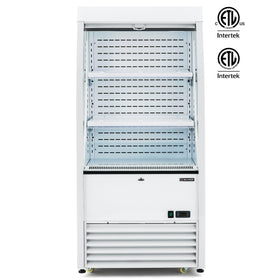
Display refrigerators, often used in supermarkets, convenience stores, and cafés, are designed for product visibility and frequent customer access. As a result, they are constantly affected by heat exchange through glass doors and repeated opening cycles. These units usually take around 1 to 3 hours to cool down initially, with an ideal temperature range of 33°F to 40°F. However, stabilization can take longer after restocking due to continuous airflow disruption.
Blast Chillers
Blast chillers are specialized commercial units designed for rapid cooling of cooked food to prevent bacterial growth. Unlike standard refrigeration systems, they are engineered for speed and food safety compliance. These units can bring food temperatures down to safe levels in 2 hours or less, depending on the load, typically reaching a holding range of 37°F to 40°F. They are widely used in commercial kitchens where food must quickly pass through the bacterial “danger zone.”
Reach-In Freezers
Reach-in freezers operate at much lower temperatures and therefore require more time to achieve full cooling stability. On average, these units take about 6 to 12 hours to reach their target range of 0°F to -10°F. Because freezing requires removing significantly more heat energy than refrigeration, compressors must work harder and longer to stabilize internal conditions. These units are essential for long-term storage of frozen foods such as meat, seafood, and prepared meals.

How Long Do You Have to Wait to Put Food in a New Fridge?
After plugging in a new refrigerator, you should generally wait about 2 to 4 hours before placing food inside, but full stabilization takes longer. This initial waiting period allows the fridge to begin cooling and reach a safe operating temperature.
In most cases, the refrigerator and freezer are not fully stable until 12 to 24 hours after startup. That means perishable foods such as meat, dairy, and seafood should only be added once the internal temperature drops below 40°F (4°C) for the fridge and 0°F (-18°C) for the freezer.
There are also a few important setup rules to follow:
- If the fridge was transported upright: wait about 2–4 hours before turning it on and beginning the cooling process.
- If it was laid on its side or back: wait at least 24 hours before plugging it in to allow compressor oil to settle.
- Check the temperature before loading food: only add highly perishable items once safe temperatures are reached.
- Help it cool faster: placing cold water bottles or ice packs inside can help stabilize temperature more quickly.
- Avoid overloading early on: leave space for air circulation and avoid adding warm food until it has cooled to room temperature.
In short, while you can begin using the fridge after a few hours, it is safest to wait up to a full day before fully loading it with perishable groceries.
Factors That Affect Refrigerator Cooling Time
Several factors influence how quickly a refrigerator reaches its optimal temperature. While most units cool within 12–24 hours, the exact timing can vary depending on design, usage, and environmental conditions.
i. Size and Internal Volume of the Fridge
Generally, the larger the refrigerator, the longer it takes to cool down. Bigger units have more internal space that needs to be brought to temperature, and it also takes longer for cold air to circulate evenly throughout the compartments.
For example, a compact mini fridge with around 1.7 cubic feet of space will cool significantly faster than a full-size 25-cubic-foot French door refrigerator.
ii. Ventilation and Airflow System
Refrigerators equipped with forced-air cooling systems (fan-assisted circulation) tend to cool more efficiently. The internal fan helps distribute cold air evenly throughout the fridge, preventing warm spots and speeding up the overall cooling process.
iii. Compressor Power
The strength of the compressor plays a key role in cooling performance. Commercial refrigerators, for instance, can often reach target temperatures in as little as 1–5 hours due to their high-powered compressors. Stronger compressors circulate refrigerant more rapidly, allowing for faster temperature pull-down from room conditions.
iv. Ambient Temperature
The surrounding environment also affects cooling speed. A refrigerator placed in a hot kitchen or garage will take longer to reach its set temperature compared to one located in a cool, climate-controlled room. The greater the temperature difference between the fridge interior and the room, the harder the system must work.
v. Initial Load Inside the Refrigerator
An empty fridge generally cools faster than one that is already stocked, especially if it contains warm food or beverages. Warm items raise the internal temperature and force the compressor to work harder, delaying the time it takes to reach safe storage conditions.
vi. Quality of Insulation
High-quality insulation helps a refrigerator retain cold air more effectively and stabilize temperature more quickly. Better insulation reduces heat exchange with the surrounding environment, while poor insulation allows heat to enter more easily, extending overall cooling time.
FAQs
Should a Fridge Be on 3 or 4?
The ideal setting depends on the model, but in most refrigerators with a 1–5 or 1–7 dial, a setting of 3 or 4 is usually recommended. This typically keeps the fridge within the safe temperature range of 37–40°F (3–4°C).
Setting it too low may cause freezing in some areas, while setting it too high can lead to unsafe food temperatures. It’s always best to confirm with a fridge thermometer rather than relying on dial numbers alone.
How Long Does It Take for Beer to Get Cold in a Fridge?
Beer usually takes about 1 to 2 hours to become noticeably cold in a refrigerator. For a fully chilled, refreshing drinking temperature, it typically needs 2 to 4 hours, depending on bottle size and starting temperature.
How Long Does a Mini Fridge Take to Get Cold?
A mini fridge generally takes 2 to 6 hours to start feeling cold and around 12 to 24 hours to fully stabilize. Smaller units cool faster, but they are also more affected by room temperature and how full they are.
How Long Does It Take for Drinks to Get Cold in a Fridge?
Most beverages take about 1 to 3 hours to get cold enough to drink. If you want them ice-cold, allow 3 to 4+ hours, especially for larger bottles or room-temperature drinks.
How Long Does It Take for Soda to Get Cold in a Fridge?
Soda typically becomes chilled in about 1 to 2 hours, but for best taste and carbonation experience, it’s better to wait 2 to 4 hours.
How Long Does an RV Fridge Take to Get Cold?
An RV fridge usually takes longer than a household fridge, typically 6 to 12 hours to cool down properly. If it’s propane-powered or absorption-based, full stabilization can take up to 24 hours.
How Long Does Water Take to Get Cold in a Fridge?
Water chills relatively quickly, usually within 1 to 2 hours. For very cold water (near fridge temperature), allow 2 to 3 hours, especially for larger bottles.
How Long Does It Take for Coke to Get Cold in a Fridge?
Coke takes about 1 to 2 hours to become cold and around 2 to 4 hours for a fully chilled, best-taste serving temperature.
How Long Does Wine Take to Get Cold in a Fridge?
Wine typically takes 2 to 4 hours to chill in a standard refrigerator. White and sparkling wines may need closer to 3–4 hours, while red wine served slightly cool may only need 30–60 minutes for a light chill.
You might be interested in:
How cold should your fridge be?